double-slit experiment

What is the double-slit experiment?
The double-slit experiment is a 19th century investigation into the properties of light that has since been found to demonstrate the wave-particle duality of photons, electrons and other particle types as well as demonstrate other quantum properties, such as superposition and interference.
Debate over whether light is made up of particles or waves dates back over three hundred years. In the 17th century, Isaac Newton proclaimed that light consists of a stream of particles. His view remained the generally accepted theory until the early 19th century, when Thomas Young devised the double-slit experiment to prove that light consisted of waves.
Young's experiments demonstrated that light behaves more like waves than particles, based on how those waves interact with each other. His experiments were repeatable and easy to perform, lending them substantial credibility. Even so, the scientific community was slow to accept his ideas. It took the work of other scientists for the community at large to accept Young's way of thinking. Eventually they did, but that all changed with the advent of quantum theory.
How does the double-split experiment work?
In the double-slit experiment, a beam of light is aimed at a barrier with two vertical slits. The light passes through the slits and hits a back screen, making it possible to observe the light's trajectory. The experiment can be performed with one or both slits open, although it is the double-slit approach that delivers the most profound results.
When one slit is covered, a single line of light is displayed on the rear screen, aligned with whichever slit is open. From these results, one might hypothesize that if both slits were open, the resulting pattern would show two lines of light, aligned with the slits. Figure 1 illustrates this concept. In this case, the experiment uses a monochromatic light (single wavelength) in the red part of the electromagnetic spectrum.
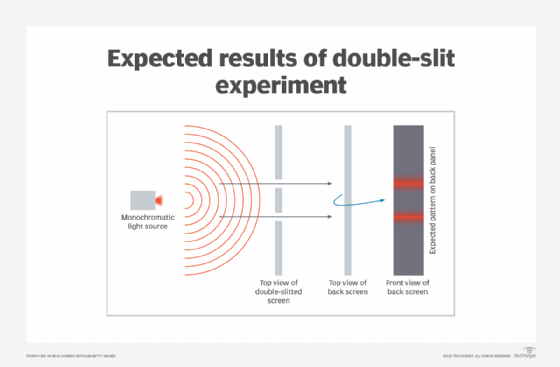
Figure 1 shows the monochromatic light source; the double-slitted screen; and the back screen, both its top view and front view. The front view displays the expected two light patterns. The results are like what might be expected if sand or some other granular material was propelled through the two slits. Whatever hits the back screen should line up with the slits. If light were to behave this way, one could assume that it is made up of particles.
What occurs in practice, however, is that the light displayed on the back screen is separated into multiple lines of lightness and darkness that vary in degree (Figure 2). These results suggest that light moves in waves rather than particles and that those waves interfere with each other as they travel toward the back screen.

When the light passes through the two slits, it forms two new waves, one for each slit. The waves spread out and overlap with each other at multiple points, much like the waves in a pond when two rocks are dropped into the water simultaneously. At the points where the waves intersect, they interfere with each other, either boosting or diminishing their strength -- an effect known as superposition. The interference between the waves is generally categorized into two types:
- Constructive interference. When the waves intersect both at their peaks or their troughs, the amplitude is boosted, resulting in a brighter section of light on the back screen.
- Destructive interference. When the waves intersect and one wave is at its peak and the other at its trough, the waves cancel each other out, resulting in a darker section on the back screen.
The constructive and destructive interference that occurs between the two waves results in a series of light and dark segments on the back screen -- an arrangement known as the interference pattern. This pattern, according to Young and other scientists, proves that light is a series of waves rather than particles.
The double-split experiment and quantum mechanics
Young's view of light persisted until the early 20th century, when the theories of quantum mechanics began to take hold. From these theories came the idea that photons, electrons and other subatomic materials possess a quality called wave-particle duality, which describes them as both waves and particles rather than one or the other.
The double-split experiment has come to play a vital role in demonstrating wave-particle duality and other quantum properties. Today, scientists can recreate the experiment with subatomic particles to demonstrate their properties. They commonly use electrons when conducting their research, although scientists have also worked with other particle types. As with light, scientists can carry out their experiments using one slit or both slits.
When they shoot electrons through a single slit, the particles hit the back screen in a pattern like what occurs with sand or a similar material. The electrons line up with the slit. However, when they shoot the electrons through two slits, the results are like those experiments done with light, indicating that the electrons somehow interfere with each other in a wave-like fashion.
This is not unexpected given how photons behave. But that behavior changes when the researchers shoot the electrons through the slits one at a time, leaving enough time between shots so the electrons can't interfere with each other. When they hit the back screen, they first appear to be spreading out randomly. But as more electrons are projected, they start lining up in the same type of interference pattern seen in the previous experiments. Somehow the electrons are aware of each other in a way that exhibits wave-like behavior, even though they're fired through the front screen one at a time.
Scientists have pushed the experiment further by adding a monitoring device that detects the number of electrons passing through each slit. During the experiment, the detector typically shows that about half of the electrons go through the first slit, and the other half go through the second slit.
What scientists also discovered is that the pattern on the back panel looks more like what occurs with grains of sand than with subatomic particles. Rather than the expected multi-line interference pattern, the back screen shows only two lines, which correspond directly to the slits. For some reason, the presence of the detector causes the electrons to behave more like particles than waves. However, if the scientists turn off the detector, the electrons once again behave like waves, spreading out on the back screen in an interference pattern.
The double-slit experiments clearly demonstrate the ways in which the particles interfere with each other as the electrons pass through the slits and spread out in waves. The experiments also demonstrate the wave-particle duality of subatomic material and the role that observance plays in particle behavior. When the electrons are observed, they behave like physical particles. When they are not observed, they behave like waves. Scientists have yet to come up with an explanation for why this occurs.