fuzzy logic

What is fuzzy logic?
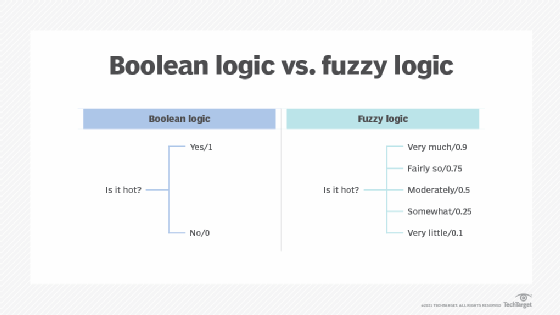
Fuzzy logic is an approach to computing based on "degrees of truth" rather than the usual "true or false" (1 or 0) Boolean logic on which the modern computer is based.
The idea of fuzzy logic was first advanced by Lotfi Zadeh of the University of California at Berkeley in the 1960s. Zadeh was working on the problem of computer understanding of natural language. Natural language -- like most other activities in life and indeed the universe -- is not easily translated into the absolute terms of 0 and 1. Whether everything is ultimately describable in binary terms is a philosophical question worth pursuing, but in practice, much data we might want to feed a computer is in some state in between and so, frequently, are the results of computing. It may help to see fuzzy logic as the way reasoning really works and binary, or Boolean, logic is simply a special case of it.
Fuzzy logic in AI
In artificial intelligence (AI) systems, fuzzy logic is used to imitate human reasoning and cognition. Rather than strictly binary cases of truth, fuzzy logic includes 0 and 1 as extreme cases of truth but with various intermediate degrees of truth.
As a result, fuzzy logic is well-suited for the following:
- engineering for decisions without clear certainties and uncertainties, or with imprecise data -- such as with natural language processing technologies; and
- regulating and controlling machine outputs, according to multiple inputs/input variables -- such as with temperature control systems.
IBM's Watson supercomputer is one of the most prominent examples of how variations of fuzzy logic and fuzzy semantics are used.
Fuzzy logic applications
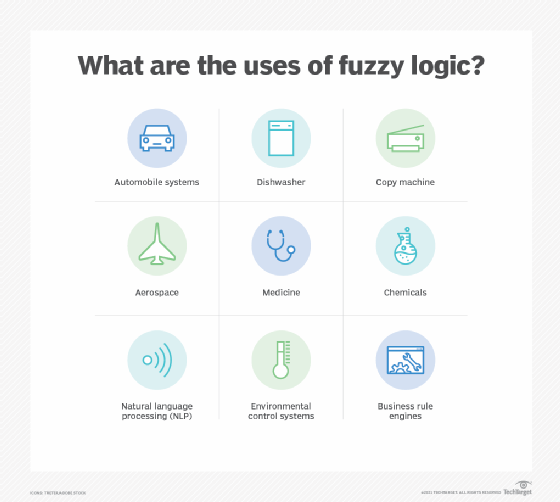
Various types of AI systems and technologies use fuzzy logic. This includes vehicle intelligence, consumer electronics, medicine, software, chemicals and aerospace.
- In automobiles, fuzzy logic is used for gear selection and is based on factors such as engine load, road conditions and style of driving.
- In dishwashers, fuzzy logic is used to determine the washing strategy and power needed, which is based on factors such as the number of dishes and the level of food residue on the dishes.
- In copy machines, fuzzy logic is used to adjust drum voltage based on factors such as humidity, picture density and temperature.
- In aerospace, fuzzy logic is used to manage altitude control for satellites and spacecrafts based on environmental factors.
- In medicine, fuzzy logic is used for computer-aided diagnoses, based on factors such as symptoms and medical history.
- In chemical distillation, fuzzy logic is used to control pH and temperature variables.
- In natural language processing, fuzzy logic is used to determine semantic relations between concepts represented by words and other linguistic variables.
- In environmental control systems, such as air conditioners and heaters, fuzzy logic determines output based on factors such as current temperature and target temperature.
- In a business rules engine, fuzzy logic may be used to streamline decision-making according to predetermined criteria.