flux

What is flux?
In physics, flux is a measure of the number of electric or magnetic field lines passing through a surface in a given amount time. Field lines provide a mechanism for visualizing the magnitude and direction of the field being measured. They are imaginary lines that follow different patterns, depending on the type of field -- electric or magnetic -- and how the field is generated.
Field lines, also called lines of force, help to visualize how flux is measured and its relationship to the electric or magnetic field. The lines' arrows show the field's direction. Their density indicates the field's strength. The greater the density, the stronger the field.
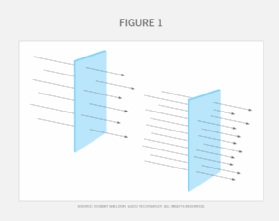
Flux is directly proportional to the number of field lines passing through a given area. The more field lines that go through an area, the greater the flux. Figure 1 shows two identical surfaces with the same area, but the number of lines passing through the surfaces is different. More lines pass through the surface on the right because the field is stronger. As a result, the surface on the right has the greatest rate of flux.
If you increase the field's strength, you increase the flux, assuming all other variables remain constant. In other words, doubling the strength doubles the flux; tripling the strength triples the flux.
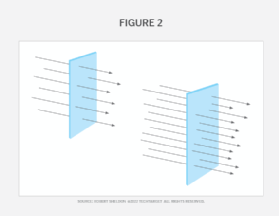
You can also increase the flux by increasing the surface area. The larger the area, the greater the number of field lines that can pass through the surface, resulting in a higher rate of flux. For example, Figure 2 shows two surfaces. The one on the right is much larger than the one on the left, but the field strength is the same in both cases. As a result, the surface on the right has a higher rate of flux.
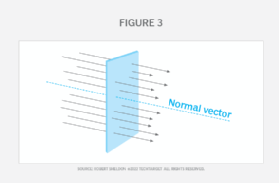
The angle at which the field lines pass through the surface also affects the rate of flux. Lines that go through at a right angle -- perpendicular to the surface -- have the highest rate of flux for a given field strength. Figure 3 shows the field lines passing through a surface at a 90-degree angle. The field lines are parallel to the normal vector -- blue dashed line -- but perpendicular to the surface. The normal vector is a reference line that is at a right angle to the surface.
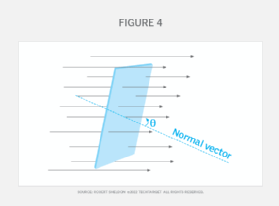
If you change the angle of the surface, you reduce the area that the field lines can pass through because less of the surface area is exposed to the electric or magnetic field. Figure 4 illustrates field lines passing through a surface at an angle. Because of the angle, some field lines now miss the surface altogether, as illustrated by the top two field lines and bottom two lines. This results in a lower rate of flux even though the surface area hasn't changed.
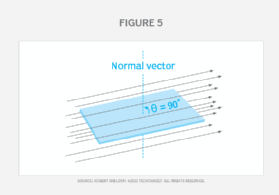
As you increase the angle between the field lines and the normal vector, the surface area exposed to the field becomes smaller, resulting in an even lower rate of flux. If the angle reaches 90 degrees, the area is said to have zero flux. Figure 5 shows a surface that is parallel to the field lines, which are at a right angle to the normal vector. At this angle, no field lines can pass through the surface, so there can be no flux.
Although field lines provide a useful way to conceptualize electric and magnetic flux, the amount of flux is determined by using a mathematical equation that multiplies the field's magnitude by the surface area and then multiplies the product by the cosine of the angle between the field lines, as shown here:
ΦE = EA cos θ
The Greek letter phi (Φ) represents flux, the uppercase E represents the magnitude of the electric field, the A represents the surface area, and the Greek letter theta (θ) represents the angle between the normal vector and the field lines. The subscripted E next to phi indicates that the formula is specific to electric flux.
The formula for calculating magnetic flux is nearly identical to the one used for electric flux:
ΦB = BA cos θ
In this case, the uppercase B represents the magnitude of the magnetic field, and the subscripted B indicates that this formula is specific to magnetic flux. The rest of the formula is the same as the one used for electricity.
In addition to its use in physics, the term flux appears in other fields, including medicine (fluids passing through or from a body), fluid dynamics (the flow of water in a stream), metalwork (a substance used to bond metals during soldering or welding), computing (as both an open source software used in developing artificial intelligence applications and in cybersecurity), common language (indicating variability) and entertainment (as a fictional vehicle part called a flux capacitor in the Back to the Future films).
See also: table of physical constants.