radio frequency (RF, rf)

What is radio frequency?
Radio frequency (RF) is a measurement representing the oscillation rate of electromagnetic radiation spectrum, or electromagnetic radio waves, from frequencies ranging from 300 gigahertz (GHz) to as low as 9 kilohertz (kHz). With the use of antennas and transmitters, an RF field can be used for various types of wireless broadcasting and communications.
How radio frequency works
Radio frequency is measured in units called hertz (Hz), which represent the number of cycles per second when a radio wave is transmitted. One hertz equals one cycle per second; radio waves range from thousands (kilohertz) to millions (megahertz) to billions (gigahertz) of cycles per second. In a radio wave, the wavelength is inversely proportional to the frequency. Radio frequencies are not visible to the human eye. As the frequency is increased beyond that of the RF spectrum, electromagnetic energy takes the form of microwaves, infrared radiation (IR), visible, ultraviolet, X-rays and gamma rays.
RF technology
Many types of wireless devices make use of RF fields. Cordless and cellphones, radio and television broadcast stations, Wi-Fi and Bluetooth, satellite communications systems and two-way radios all operate in the RF spectrum. In addition, other appliances outside of communications, including microwave ovens and garage door openers, operate at radio frequencies. Some wireless devices, like TV remote controls, computer keyboards and computer mice, operate at IR frequencies, which have shorter electromagnetic wavelengths.
How the radio frequency spectrum is used
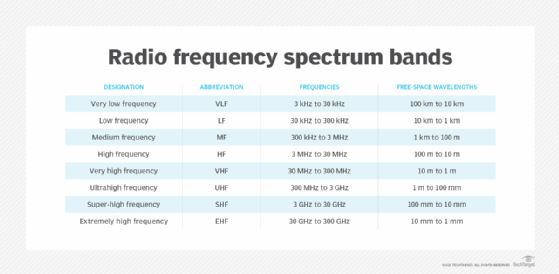
The radio frequency spectrum includes the set of frequencies of the electromagnetic framework ranging from 30 Hz to 300 GHz. It is divided into several ranges, or bands, and given labels, such as low frequency (LF), medium frequency (MF) and high frequency (HF), for easier identification.
With the exception of the lowest-frequency segment, each band represents an increase of frequency corresponding to an order of magnitude (power of 10). The following table depicts the eight bands in the RF spectrum, showing frequency and bandwidth ranges. The super high frequency (SHF) and extremely high frequency (EHF) bands are often referred to as the microwave spectrum.
RF congestion and interference
In the United States, radio frequencies are divided into licensed and unlicensed bands. The Federal Communications Commission (FCC) issues licenses that permit commercial entities to have exclusive use of a frequency band in a given location. Entities include frequency modulation (FM) radio, cellular networks, television, military and satellite communications. Unlicensed frequencies are free for public use but remain a shared medium.
The competition for bandwidth and channels from internet users has increased dramatically in recent years, leading to signal issues. In addition, distribution across frequencies is not equitable. In many locations, it is possible to find broadcasters -- radio and TV stations -- with their own individual frequencies, while a multitude of sources compete for space on the unlicensed frequencies.
Heightened demand has led to a number of innovations geared toward improved spectrum efficiency, including dynamic spectrum management, trunked radio, frequency pooling, spread spectrum, cognitive radio and ultra-wideband.
How cellular networks use RF
A cellular network typically covers a specific geographical area divided into cells. Every cell is allocated a set of frequencies that have radio base stations assigned to them. When a communication such as a cellular phone call is initiated, the device searches for the closest base station to establish a radio link. When receiving the call, the base station antenna establishes a connection with the phone. Phones are designed to periodically check in with the network, making it easier for them to receive a radio signal of substantial quality from a nearby base station antenna.
RF technology allows a set of frequencies to be used in other cells, as long as the cells aren't bordering each other. It is possible for numerous callers in one area to use the same frequency because calls can be switched to the closest base station with that particular frequency. This increases the capacity of the cellular network. However, the frequency reuse works only for unrelated transmissions. Users can still experience some interference from signals coming from other cells using the same frequency. This is why wireless networks use a system of frequency-division multiple access (FDMA), in which there must be at least one cell in between cells reusing the same frequency.
FDMA enables numerous users to send and receive data through the same communication channel. Cellular network users can also move from one cell to another while calling, without calls being dropped. Through the handover process, the mobile device remains aware of signal quality and the nearest antenna with the least congestion. When need be, the mobile device switches to a new and more convenient channel.
How 5G uses RF
Wireless 5G-enabled devices connect to the internet and telephone networks using radio waves that go through a nearby antenna. As the upcoming iteration of wireless broadband network technology, 5G provides peak speeds as high as 10 gigabits per second (Gbps) for downloads. 5G can operate on low frequencies (below 6 GHz), as well as HF ranges, commonly known as millimeter waves, or MM waves (higher than 6 GHz). The higher the frequency, the more likely the user is to experience higher data transfer speeds.
5G networks will, therefore, provide more capacity and will serve as a channel for internet service providers (ISPs) that can compete with wired internet services. 5G networks may also facilitate greater connectivity for the internet of things (IoT), smart cities and advanced manufacturing processes, to name a few.
5G achieves its increased capacity by using up to three different types of cells -- macrocell, small cell and femtocell -- each with unique antenna designs. Some of these antennas will provide higher speeds, while others will cover longer distances. Because 5G operates in LF, MF and HF bands, the appropriate hardware depends on the best possible route for users and their data.
5G networks are also capable of reducing latency to achieve faster response. They are expected to provide a more consistent user experience (UX), even when users move around frequently. The advent of 5G new radio (5G NR) standards is also expected to increase coverage areas and improve connection quality, as well as speed and data rates.
To learn more about radio frequency and its usage in the U.S., read this article on licensed and unlicensed bands.