electric field strength

What is electric field strength?
Electric field strength is a quantitative expression of the intensity of an electric field at a particular location. The standard unit is the volt per meter (V/m or V·m-1). A field strength of 1 V/m represents a potential difference of 1 V between points separated by 1 meter. Electric field strength is also referred to as electric field intensity.
Any electrically charged object produces an electric field. The field exerts a force on other charged objects in the vicinity, repelling like charges and attracting opposite charges. The field strength of the source object can be measured at specific vector points within that field. Each vector point reflects both the magnitude and direction of the electric force at that point.
How to measure electric field strength
To measure the field strength, a test charge positioned at one of the vector points within the electric field of the source object is needed. This test charge should have a small positive charge that does not interfere with the source charge. The test charge makes it possible to measure the electric field strength of the source charge at the vector point where the charge is positioned.
The electric field strength at a specific vector point is directly proportional to the electric charge -- in coulombs (C) -- of the source object. In addition, the field strength is inversely proportional to the distance between the source object and the test charge vector point. The field strength vs. distance curve is a direct inverse function and not an inverse square function. This is because electric field strength is specified in terms of linear displacement (per meter) rather than a surface area (per meter squared).
The electric field strength can be represented mathematically with the following formula:
E=F/q
In this formula, E represents the electric field strength, F refers to the force exerted by the source charge (in newtons) and q is the test charge (in coulombs). The value of F is calculated by using the following formula:
F=(k·Q·q)/d2
In this case, F again represents force, k equals the coulomb constant, Q refers to the source charge (in coulombs), q is the test charge (in coulombs) and d is the distance between Q and q. When F is inserted into the original electric field strength formula, the results are returned as newton per coulomb (N/C), which directly equate to volts per meter. For example, 500 N/C is equal to 500 V/m, and 1,000 N/C is equal to 1,000 V/m.
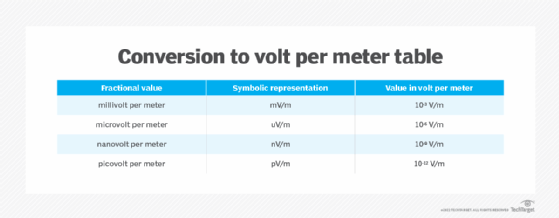
Sometimes, the strength of an electromagnetic field is specified in terms of the intensity of its electric field component. This is done by engineers and scientists when talking about the radio frequency field strength at a certain location from sources such as distant transmitters, celestial objects, high-tension utility lines, computer displays or microwave ovens. In this context, electric field strength is usually specified in smaller granularities, as shown in the table.
See also: International System of Units and table of physical units.