element

What is an element?
An element is a fundamental item that can't be easily broken into smaller pieces. In chemistry and physics, an element is a substance that can't be broken down by non-nuclear reactions. In computing and mathematics, an element is a distinct piece of a larger system or set.
Elements in chemistry and physics
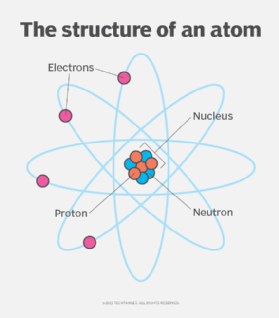
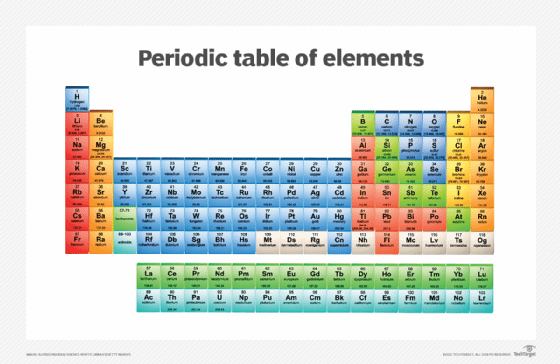
Elements are the building blocks of chemistry and matter. Each element is defined by the number of protons in its nucleus. The chemical elements are organized on the periodic table of the elements. Each element has an atomic number and a symbol. The symbol may be based on the Latin name of the element and not be related to the English name.
Each atom is an element. Atomic elements create bonds to form molecules.
How are elements classified?
Each element is classified by the number of protons in its nucleus, known as its atomic number. The number of neutrons in the nucleus can vary, creating isotopes. Isotopes will have the same chemical properties, but different physical ones. For example, common hydrogen has one proton and no neutrons, deuterium has one proton and one neutron, and tritium has one proton and two neutrons. However, all three can be classified as the element hydrogen.
The same element can also vary in the number of electrons it has, creating ions. For example, sodium (Na) is a highly reactive element. Na can form an ionic bond with chlorine (Cl) where the sodium loses an electron -- becoming Na+ -- and gives it to the chlorine atom -- which then becomes Cl- -- to form common table salt.
Some examples of chemical elements are:
- Hydrogen (H),
- Helium (He),
- Carbon (C),
- Oxygen (O),
- Sodium (Na),
- Iron (Fe),
- Lead (Pb) and
- Gold (Au)
The periodic table of elements has 118 different elements, and 94 of these are known to occur in nature. The other 24 elements have been synthesized in particle accelerators and are unable to stay stable for long periods of time; these are known as man-made elements.
How are elements made?
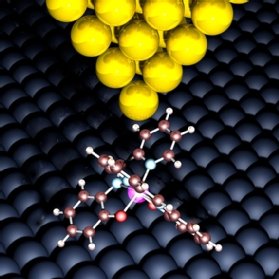
Chemical reactions can't change one element to another. The nature and properties of an element are set by the number of protons and neutrons in its nucleus. The strong nuclear force holds an atom's nucleus together and is difficult to break. Chemical reactions such as burning or bonding into atoms can't alter the nucleus of an atom and can't change an element. A nuclear reaction is required to alter the nucleus of an atom.
To illustrate the immutability of an element, imagine a carbon atom. The carbon atom starts off bonded to oxygen in a carbon dioxide (CO2) molecule. Carbon dioxide is captured by trees and, using the photosynthesis chemical reaction, the carbon is stripped out of the CO2 molecule and added to a glucose molecule. The glucose is then used to form the cellulose of a tree's cell walls. When the tree is burned, it becomes coal, which is primarily a lump of compressed carbon. When the coal is crushed under immense pressure, the carbon atoms are rearranged into a diamond. During this entire process, the carbon has gone through many reactions and been in different molecular structures, but it hasn’t changed from one element into another.
The only way to change one element into another is to use a nuclear reaction. In nuclear fission, a heavy element with many protons and neutrons is split into lighter elements. In nuclear reactors, the element uranium is split by collisions with free neutrons that release energy. In nuclear fusion, light elements have their nucleases forced together to form a heavier element. Nuclear fusion happens in the heart of a star when hydrogen is fused into helium; as the star ages and its gravity increases, it’s crushed into progressively heavier and heavier elements.
History of chemical elements
From ancient times, it was understood that some items could be turned into others, such as a log being burned or a person eating food. People therefore believed that most items could be broken into simpler forms until the smallest indivisible part was reached. The ancient philosopher Plato is credited as the first person to use the term element, from the ancient Greek stoikheîon – meaning one of a series, component – and the Latin elementum – meaning basic principle or rudiment. Most ancient Greeks believed there were four elements -- air, water, earth and fire -- while Aristotle defined dry, moist, hot and cold as elements that could be combined to form air, water, earth and fire.
Alchemists identified certain substances -- such as lead, gold, mercury and sulfur -- that couldn't be changed. In the 1600s, as more of these indivisible substances were discovered, Robert Boyle defined an element as simple substances that can't decompose or be broken down into component substances.
In 1789, Antoine Lavoisier wrote "Elementary Treatise on Chemistry," which is considered the first modern book on chemistry. He defined an element as a simple substance that can't be broken down further and listed many of the elements that we know of today. He arranged the elements into metallic and non-metallic categories.
In the early 1800s, John Dalton proposed atomic theory and was able to determine the atomic weights of many elements. In 1869, Dimitri Mendeleev organized the known elements by atomic weight and grouped them according to similar properties. He also made predictions about then unknown elements based on his research. This was eventually refined into what's now known as the periodic table of the elements.
Elements in computing
The term element is used in computing to refer to a smaller component of a larger system.
In computer programming, an array is a stored list of individual elements or pieces of data.
Web programming uses HTML elements. An HTML element is a complete piece of the page, consisting of an opening tag, the data and the closing tag.
See also: compound, atomic mass unit, matter, table of physical constants, Table of Physical Units