absolute truth

What is absolute truth?
In general, absolute truth is whatever is always valid, regardless of parameters or context. The absolute in the term connotes one or more of: a quality of truth that cannot be exceeded; complete truth; unvarying and permanent truth.
Absolute truth can be contrasted with relative truth, or truth in a more ordinary sense, in which a degree of relativity is implied. Relative truth is conditional, subjective, varying and contradictory, so it's capable of changing over time. In contrast, absolute truth is consistent and eternal; its meaning is universal and never changing.
The topic of absolute truth -- or universal truth -- comes up in different contexts, often as part of a larger discussion about the viability of absolutism or in contrast with relative truth.
Absolute truth and philosophy
Philosophers have long debated the existence of absolute truth. Philosophical absolutism argues that there exists a reality outside our everyday perception. This concept of absolute truth is similar to Plato's description of the ideal, which focuses on what is essential rather than superficial. Our perception of the physical world, according to Plato, is merely a shadow of the ideal.
In contrast, philosophical relativism posits that what is defined as truth depends on circumstances and is subject to change. Some believe that the existence of relative truth does not necessarily preclude absolute truth, or vice versa, although even this is contested in some circles.
Religion and absolute truth
Among some religious groups, the term absolute truth is used to describe the source of, or authority for, a given faith or set of beliefs, such as those found in the Bible, Quran or Torah. However, conflicts can arise when the absolute truths of one belief system clash with those in another belief system.
On the other hand, some individuals propose that absolute truth cannot be represented by language or known through knowledge or dogmatic viewpoints, but rather it must be realized by abandoning theories and ideologies altogether.
Science and absolute truth
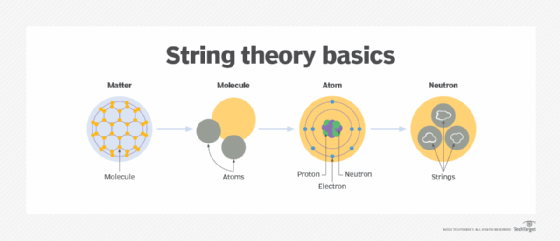
The scientific community tends to shy away from the notion of absolute truths, especially since the advent of the theory of relativity, quantum mechanics and similar theories. Although scientific theory is repeatedly tested and substantiated, it can still be disproved at some point. Attempts to define a single unified theory -- such as string theory or M-theory -- could be seen as efforts to discover the absolute truth about the universe, but even those are never described as anything more than theoretical models.
Science revolves around a collection of theories that attempt to describe the natural world and the universe as they're currently understood, but as that understanding evolves, so do the theories on which science is based.
Absolute truth in mathematics
Some believe that pure mathematics proves the existence of absolute truth. As evidence of this, they point to mathematical structures such as Maxwell's equations as a type of absolute truth. Introduced in the 19th century, the equations describe the fundamentals of electromagnetism. Maxwell's equations have played a pivotal role in designing today's electrical and electronic equipment, from electric motors to smartphones to the satellites circling Earth.
Despite the seeming universality of mathematical structures such as Maxwell's equations, the question of whether mathematics -- or at least parts of mathematics -- represents a type of absolute truth remains an ongoing debate.
The debate over the existence of absolute truth
In fact, the question of whether absolute truth exists in any field or discipline continues to be hotly debated. Some have argued that all truth is relative and no absolute truth exists. But this conclusion is self-contradictory because it uses an absolute truth to negate the existence of absolute truth.
Proponents of absolute truth can also have a difficult time arguing their case because of the challenge in proving that a fact is absolutely true in all places, times and circumstances, and in a way that can be verified and never refuted -- whether talking about God, the devil, heaven, hell or extraterrestrials from another galaxy. At the same time, arguing against the absolute truth of such concepts is just as much of a challenge because of the difficulty of presenting irrefutable facts to prove their nonexistence.
The incompleteness theorems, published by Kurt Gödel in 1931, state that there exist true statements in mathematics that cannot be proved. This means that a mathematical statement can be true but still be unprovable, undercutting the long-held belief that all mathematical statements are either provable or refutable.
See also: scientific method, single source of truth, fuzzy logic, truth table